Two years ago, when a client asked me how to use ChatGPT tool for digital marketing, I thought it would just be another tool. My first reaction was, “Seriously? We’re going to let a robot write content?”
But after seeing how I reduced the creation of a complete article from days to hours (while maintaining the quality), and verifying that my AI-optimized articles can rank as well as 100% manual ones… well, here we are.
I am not going to sell you the idea that “AI does everything”. Because that is a lie, but I will tell you exactly how I use these tools to be more efficient without losing the quality.
Key Takeaways
- What AI tools actually help in digital marketing (and which don’t)
- The main categories of AI tools you should understand
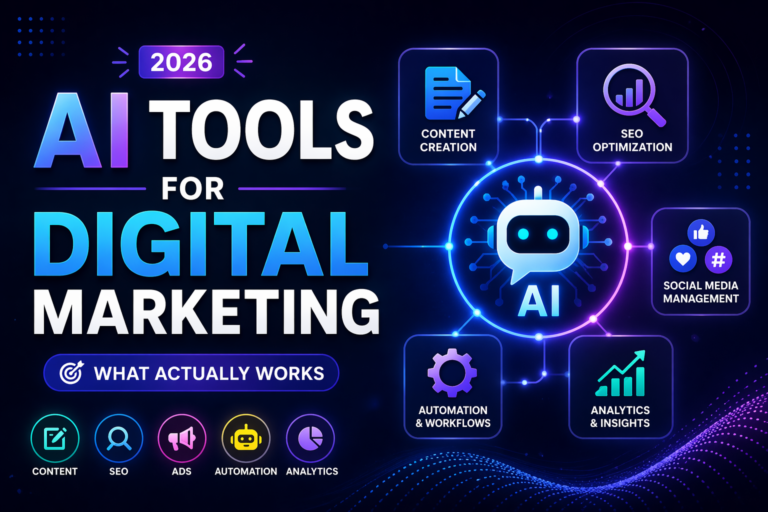
- The best tools for content, SEO, ads, and automation
- When to use each tool instead of guessing
- Simple workflows that actually save time
- How to choose tools without overcomplicating your setup
Best AI Tools for Digital Marketing (Quick Answer)
If you just want a starting point without overthinking it:
- ChatGPT → content and ideas
- Surfer SEO or Semrush → SEO
- Canva AI → visuals
- Zapier or Make → automation
- AdCreative → ads
That setup alone is enough for most marketing tasks. You can always expand later once you understand what you actually need.
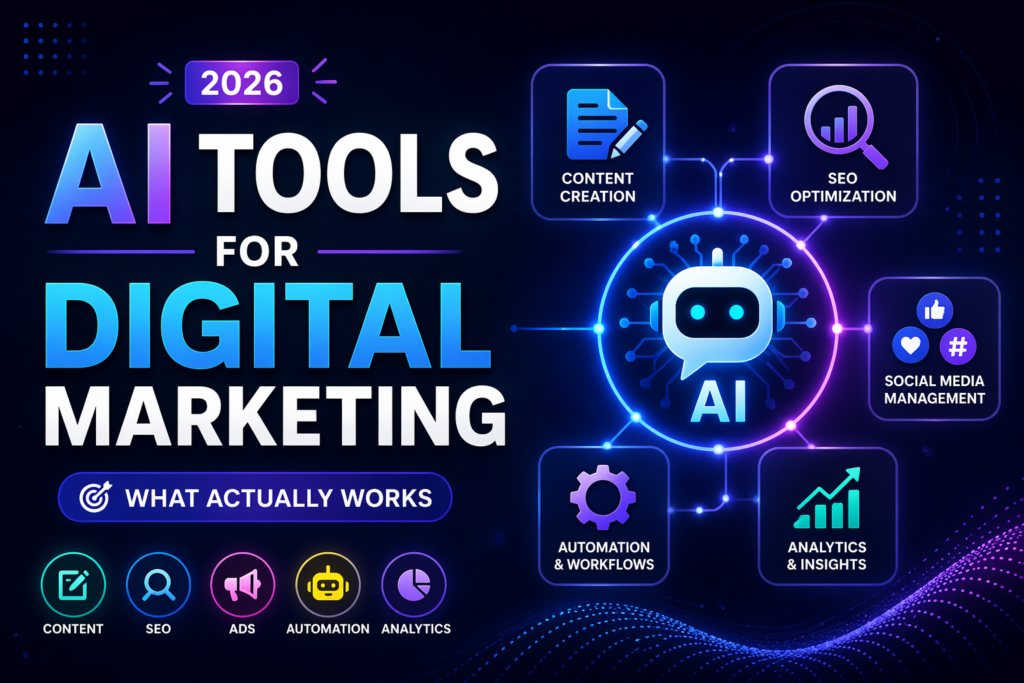
Types of AI Tools Used in Digital Marketing
When I talk about artificial intelligence in digital marketing, I am not referring to the robots that will do all the work for you.
I am talking about the AI marketing tools that can analyze your competition, optimize your content, and automate repetitive tasks that usually take hours.
This is where most people get confused. They try one tool and expect it to handle everything.
That doesn’t work.
Because each tool is designed for a specific task and once you understand that, choosing the right tool becomes much easier.
Content Tools
This is one of the highest-demand categories, isn’t it? Most of them use these AI tools for content almost every day.
They help in writing the blogs, ads, emails, and even scripts.
Tools like ChatGPT, Jasper, and Copy.ai fall into this category. If you’re creating content regularly, this is where you start.
SEO Tools
Random content doesn’t bring traffic.
To rank, we need proper keyword analysis, and these SEO tools will help you find keywords, understand your competition, and optimize your content.
Tools like Semrush, Ahrefs, Surfer SEO, and Frase fall into this category. If your goal is organic traffic, these tools are not optional.
Social Media Tools
Creating content is one part. Posting consistently is another.
These tools help with ideas, captions, and scheduling. Predis.ai and Buffer are commonly used here.
They don’t replace your strategy, but they make execution easier.
Ads & PPC Tools
Running ads without optimization gets very expensive quickly.
These tools help you create better creatives and improve targeting. AdCreative and built-in AI features in platforms like Google Ads and Meta fall into this category.
If you are spending on ads, these tools can make a real difference.
Automation Tools
This is where things get interesting. Automation tools connect different apps and remove repetitive work.
Zapier, Make, and n8n are the main players here.
Most people will ignore this category, but this is where you actually save the most time.
Analytics Tools
You can’t improve when you don’t measure.
Analytics tools help you understand what’s working and what’s not.
Google Analytics, Power BI, and Tableau are commonly used. They don’t create results, but they help you make better decisions.
AI Tools for Digital Marketing Comparison Table
If you don’t want to read everything, this comparison will give you a quick overview. These are the tools most marketers are using right now, grouped by what they are best at.
| Tool | Category | Best For | Free Plan | Paid |
|---|---|---|---|---|
| ChatGPT | Content | Writing, ideas | Yes | Yes |
| Jasper | Content | Marketing copy | No | Yes |
| Canva AI | Content | Design + visuals | Yes | Yes |
| Semrush | SEO | Keyword research | No | Yes |
| Surfer SEO | SEO | Content optimization | No | Yes |
| Predis.ai | Social | Social posts | Yes | Yes |
| AdCreative.ai | Ads | Ad creatives | No | Yes |
| Zapier | Automation | Integrations | Yes | Yes |
| Make | Automation | Workflows | Yes | Yes |
| Power BI | Analytics | Data insights | Yes | Yes |
You don’t have to try all of these. Just focus on what matches your current goal.
Best AI Tools for Digital Marketing by Use Case
If you are not sure where to start, don’t overthink it. Pick tools based on what you’re trying to do in your marketing.
For Content Marketing
If you are creating blogs, landing pages, or emails:
- ChatGPT → ideas, drafts, rewriting
- Jasper → structured marketing content
Start with ChatGPT and add Jasper if you need more control.
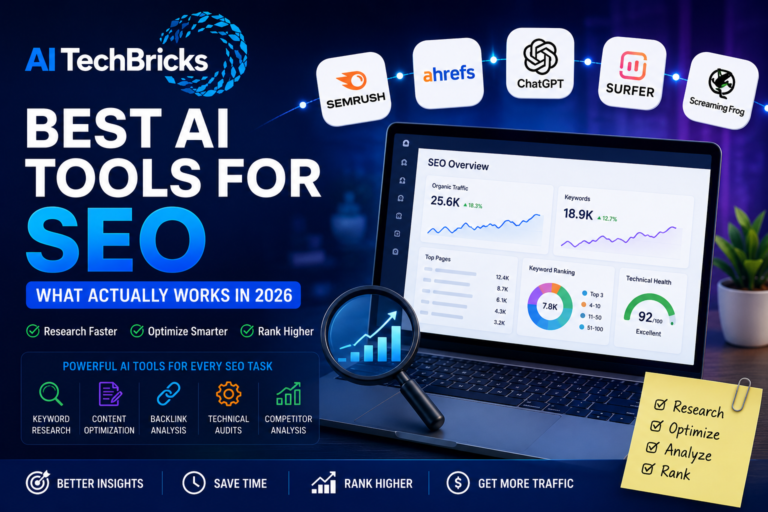
For SEO
If your goal is to get traffic from search:
- Semrush → keyword research and competition
- Surfer SEO → content optimization
Use Semrush to find topics. Use Surfer to make them rank.
For Social Media Marketing
If you are posting consistently:
- Predis.ai → content ideas and posts
- Buffer → scheduling
This will help you to stay consistent without spending too much time.
For Paid Ads
If you are running campaigns:
- AdCreative → ad creatives
- Google Ads AI → optimization
These tools will improve execution, not strategy.
For Marketing Automation
If you are repeating the same tasks:
- Zapier → simple automation
- Make → advanced workflows
This is where you will save the most time.
For Beginners in Digital Marketing
If you are just starting:
- ChatGPT
- Canva AI
That is enough to begin. You don’t need a full setup yet.
Choosing the tool is very simple. Understand your goal and use tools based on your marketing task. Don’t just use any tool just because they are popular.
When Should You Use Each AI Tool?
Use ChatGPT when you need speed
If you are starting from scratch or stuck, use ChatGPT.
It helps you move quickly from idea to draft. Not perfect, but fast.
Use Semrush when you need direction
If you don’t know what to write, start here.
It shows what people are searching and what competitors are doing.
This is where the strategy begins.
Use Surfer when you want to rank
Once your content is ready, use Surfer to optimize it. It helps match what Google is already rewarding.
Use Canva when visuals matter
If you are creating blog images or social posts, Canva saves time. Best thing is you don’t have to be a pro-designer to create designs.
Use Zapier when tasks repeat
If you are doing the same thing again and again, automate it. Zapier connects tools and runs things in the background.
Real AI Workflows for Digital Marketing
This is where AI starts to make a real difference. Using a single tool helps but combining them will actually save time and gives better outputs.
Content Marketing Workflow with AI Tools
If you are creating blog content regularly, this is the simplest setup.
ChatGPT → Surfer SEO → Canva
- Start with ChatGPT to generate ideas and drafts.
- Use Surfer to optimize the content for SEO.
- Then use Canva to create visuals.
This alone can cut your content creation time in half.
AI SEO Workflow
If your focus is ranking on Google, start here.
Semrush → ChatGPT → Surfer SEO
- Use Semrush to find keywords and analyze competitors.
- Use ChatGPT to create the initial draft.
- Then optimize it using Surfer.
This helps you go from idea to publish-ready content faster.
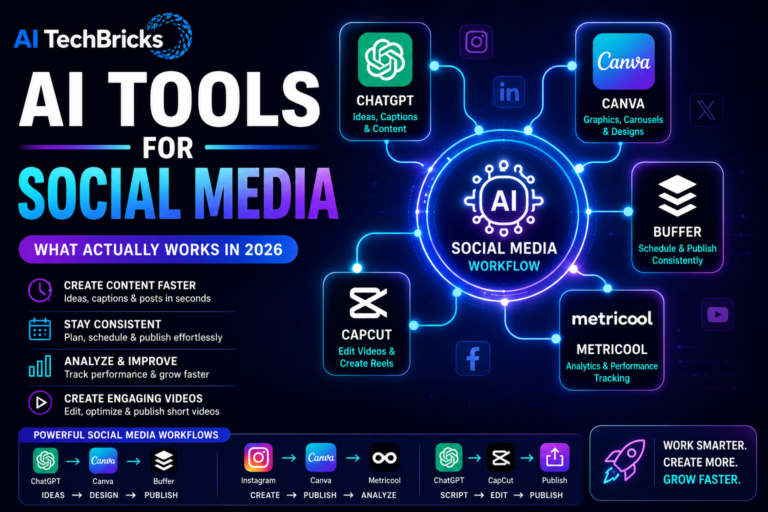
Social Media Workflow
If you are posting consistently:
ChatGPT → Predis.ai → Buffer
- Generate ideas and captions using ChatGPT.
- Create posts using Predis.
- Schedule everything using Buffer.
This keeps your posting consistent without spending hours daily.
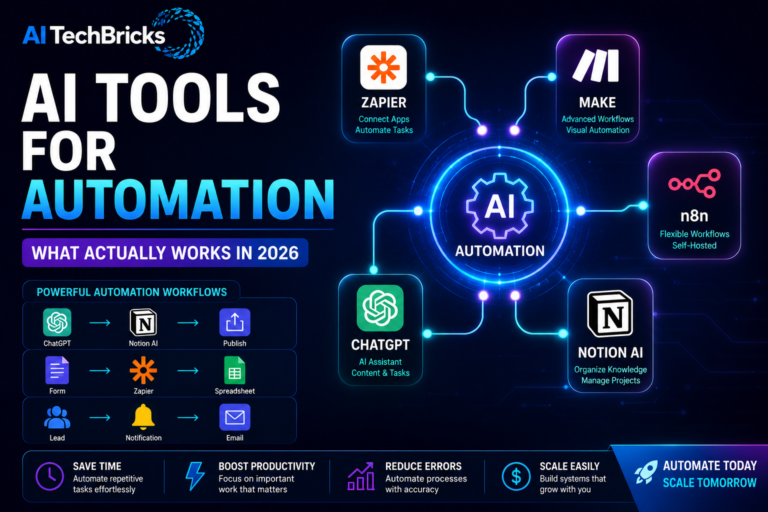
Lead Generation Workflow
If you are collecting leads:
Landing Page → Zapier → Email Tool
- Capture leads through a form or landing page.
- Use Zapier to send data automatically.
- Trigger emails or store leads without manual work.
This runs in the background once it is properly set up.
Ads Workflow
If you are running paid campaigns:
AdCreative → Ads Platform → Analytics
- Generate multiple ad creatives quickly.
- Run them through Google Ads or Meta.
- Track performance and adjust based on results.
This helps you test faster and find what works.
The idea here is very simple. Rather than using every tool individually, build a small workflow around your tasks, and that is where the real efficiency comes from.
Insights from Using AI Tools in Digital Marketing
After working with these tools for different use cases, a few patterns have become clear. Most tools are focused on content and SEO. That is where the demand is.
Automation tools are still underused. But once you start using them, you don’t go back.
No single tool does everything well. Each one has its role. And the biggest difference is not the tool, but the way you use it.
Some people use five tools and get no results. Others use two tools and build systems that actually work.
How to Choose the Right AI Tools for Digital Marketing
Don’t try to find the “best tool.” Start with what you actually need. If you’re creating content, start there. If you want traffic, focus on SEO. If you are repeating tasks, look at automation.
Keep it simple. You don’t need a complex setup on day one. Start with one or two tools. Understand how they work. Then expand only when needed.
Free vs Paid AI Tools for Digital Marketing
Free tools are good enough to get started. You can learn, test, and even create decent output. But once you start getting results, you will notice the limits.
That is where paid tools make sense. Not because they are better, but because they save time.
FAQs
What are the best AI tools for digital marketing?
There isn’t one “best” tool. It depends on what you’re trying to do.
For content, tools like ChatGPT and Jasper work well. For SEO, Semrush and Surfer are commonly used. For automation, Zapier and Make are popular.
Most marketers use a combination, not just one tool.
Can I use AI tools for digital marketing for free?
Yes, you can start with free tools.
ChatGPT, Canva AI, and Zapier offer free plans that are enough for beginners.
But once you start getting results, you’ll likely need paid tools to scale and save time.
Do I need multiple AI tools?
Yes. One tool can’t handle everything. You might use one tool for content, another for SEO, and another for automation. That’s how most real workflows work.
How do AI tools actually help in digital marketing?
They reduce the time spent on repetitive work. You can generate content faster, optimize for SEO, automate tasks, and analyze data more easily. They don’t replace strategy—but they make execution faster.
Which AI tool should beginners start with?
Start simple. ChatGPT for content and Canva AI for visuals are enough in the beginning. Once you understand your workflow, you can add more tools.
Can AI replace digital marketers?
No. AI can assist with tasks, but it doesn’t replace thinking, strategy, or creativity. It’s a tool, not a replacement.