Just like every other software, AI is upgrading every day, in fact, every hour. Yesterday we saw AI doing some basic tasks, and today, it is doing all of our major functions, which is saving almost an hour per day.
While this is quite exciting, did you realise that it is actually impacting people’s lives? On reddit, some says it is becoming you.
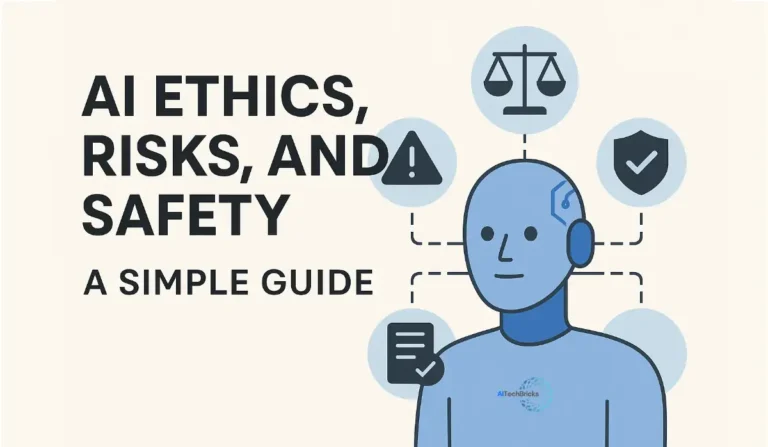
And that’s where AI ethics, risks, and safety come in, not to scare anyone, but to make sure AI is built and used properly with responsibility.
Because even the smartest systems can make silly mistakes, misunderstand context, create unfair outcomes, or be misused by the wrong people.
So this guide breaks everything down in simple English:
What AI ethics means, why it matters in 2026, the risks to watch out for, how companies handle safety, and how we can build AI that helps people instead of harming them.
Table of Contents
What Is AI Ethics? (Simple Explanation)
AI ethics is basically about one question:
“Is this AI being fair, safe, and responsible when used on real people?”
That is it.
AI ethics exists because AI systems don’t live in a vacuum.
They influence hiring decisions, loan approvals, medical suggestions, content moderation, recommendations, and even legal or policing tools in some countries.
And when AI gets things wrong, real humans feel the impact.
AI Ethics in Plain English
AI ethics focuses on making sure AI:
- treats people fairly
- doesn’t discriminate
- respects privacy
- explains its decisions
- stays under human control
- avoids causing harm
It’s not about stopping AI progress.
It’s about guiding it responsibly.
Simple Everyday Examples
- If an AI rejects a job application, you should know why.
- If an AI recommends a loan, it shouldn’t favour one group unfairly.
- If an AI chatbot gives medical advice, it must be accurate and safe.
- If an AI uses your data, it should protect it properly.
When these rules aren’t followed, trust breaks.
Why AI Ethics Matters More in 2026?
Because AI today is:
- more powerful
- more autonomous
- more widely used
- embedded into daily life
Earlier, AI was just a tool.
Now, AI is making decisions at scale.
And decisions at scale need responsibility at scale.
Key Ethical Issues
When people talk about “AI ethics,” they usually mean a few core issues that show up again and again.
These aren’t abstract ideas, they affect real users, real decisions, and real outcomes.
Let’s break them down one by one.
Bias
AI learns from data.
And data comes from humans.
So if the data is biased, the AI often becomes biased too.
What this looks like in real life:
- Hiring tools favoring certain genders or backgrounds
- Facial recognition working poorly for some skin tones
- Credit or loan systems rejecting specific groups more often
Why it matters:
Bias can quietly amplify inequality, at massive scale.
Fairness
Fairness is about making sure AI decisions don’t disadvantage people unfairly.
Bias and fairness are related, but not the same.
Example:
Two people with similar qualifications should get similar outcomes, whether that’s a job interview, a loan, or a recommendation.
The challenge:
“Fair” can mean different things in different contexts, and AI needs clear rules to follow.
Privacy
AI systems often use huge amounts of personal data.
That raises simple but serious questions:
- What data is being collected?
- Who owns it?
- How long is it stored?
- Can it be misused or leaked?
Real-world concern:
AI trained on personal data without consent or proper protection can violate user trust and laws.
Transparency
Transparency means understanding how and why an AI made a decision.
If an AI says:
“Application rejected.”
The next question is obvious:
“Rejected because of what?”
Why transparency matters:
- Users deserve explanations
- Regulators require it
- Businesses need accountability
Black-box decisions create confusion and mistrust
Accountability
When AI makes a mistake, someone has to be responsible.
Not:
- “The model did it.”
- “The system decided.”
But a real human or organization.
Accountability answers questions like:
- Who is responsible for AI outcomes?
- Who fixes mistakes?
- Who is legally liable?
Without accountability, AI failures turn into blame games.
AI Risks
AI is powerful. And like any powerful tool, things can go wrong if it’s poorly designed, badly trained, or misused.
These risks don’t mean “stop using AI.” They mean use AI with awareness and guardrails.
Let’s look at the main ones.
Data Leaks & Privacy Breaches
AI systems often handle sensitive data:
- personal details
- company documents
- financial information
- medical records
If data isn’t protected properly, leaks can happen.
Why this is risky:
- user trust breaks
- legal trouble
- financial loss
- reputational damage
AI is only as safe as the systems around it.
Hallucinations (Confidently Wrong Answers)
Sometimes AI gives answers that sound correct… but aren’t.
This is called a hallucination.
Examples:
- fake facts
- made-up sources
- incorrect medical or legal advice
- wrong summaries
Why this matters:
People often trust AI too quickly, especially when answers sound confident.
Misuse of AI
AI can be used for good… or misused.
Examples of misuse:
- scam emails
- fake customer support bots
- misinformation campaigns
- plagiarism at scale
The same tools that help businesses can be abused by bad actors.
Deepfakes & Synthetic Media
AI can now generate:
- realistic images
- convincing voices
- fake videos
This creates serious risks:
- fake political speeches
- impersonation scams
- misinformation
- reputation damage
As these tools get better, spotting what’s real becomes harder.
Over-Automation
Just because something can be automated doesn’t mean it should be.
Over-automation happens when:
- humans are removed too early
- AI decisions aren’t reviewed
- edge cases are ignored
Result:
Small errors turn into big problems — very fast.
Job Displacement Concerns
This is the question everyone asks.
AI can automate tasks.
Some roles will change.
Some tasks will disappear.
But historically:
- new tools → new roles
- new skills → new opportunities
The real risk isn’t AI replacing people.
It’s people not adapting to new tools.
AI Safety Principles
AI safety isn’t about slowing innovation. It’s about making sure AI behaves in ways that align with human values, rules, and expectations.
Most responsible AI systems today follow a few core safety principles. Let’s break them down simply.
Human-in-the-Loop
This means humans stay involved, especially in important decisions.
AI can assist, suggest, analyze, and automate, but final authority stays with people.
Where this is critical:
- hiring decisions
- loan approvals
- medical advice
- legal judgments
- financial actions
AI helps. Humans decide.
Alignment
Alignment means making sure AI goals match human goals.
If an AI is told to “optimize engagement,” but does that by spreading harmful content — that’s misalignment.
Good alignment means:
- clear instructions
- defined boundaries
- ethical objectives
- user-first outcomes
AI should work with human intent, not against it.
Guardrails
Guardrails are safety rules built into AI systems.
They prevent AI from:
- generating harmful content
- sharing sensitive data
- giving dangerous advice
- acting outside its allowed scope
Think of guardrails like lane markings on a road — they don’t stop movement, they keep it safe.
Monitoring & Evaluation
AI systems aren’t “set and forget.”
They need:
- regular testing
- performance reviews
- bias checks
- accuracy tracking
- feedback loops
Why?
Because data changes, users change, and real-world behavior is messy.
Monitoring helps catch problems early.
Transparency & Documentation
Responsible AI systems are documented clearly.
This includes:
- what data was used
- what the model can and can’t do
- known limitations
- safety measures in place
Clear documentation builds trust, internally and externally.
How Companies Implement Safe AI
Big AI companies don’t just release models and hope for the best.
They follow the structured safety frameworks to reduce risk, improve reliability, and stay accountable.
Let’s look at how this works in practice, without going too technical.
OpenAI: Safety by Design
OpenAI focuses heavily on preventing misuse before it happens.
Key approaches:
- Built-in content guardrails
- Model alignment through training
- Red-teaming (testing models with adversarial prompts)
- Usage policies and monitoring
- Gradual feature rollouts
What this means:
Models are tested aggressively before public release, and risky behaviors are restricted early.
Google: Responsible AI Framework
Google follows a structured Responsible AI approach across all products.
Core principles include:
- Be socially beneficial
- Avoid creating or reinforcing unfair bias
- Be accountable to people
- Provide transparency
- Maintain high safety standards
How it’s applied:
- Model cards explaining capabilities and limits
- Bias evaluation before deployment
- Clear internal approval processes
- Human review for high-impact use cases
Anthropic: Safety-First Model Development
Anthropic was built specifically around AI alignment and safety.
Key ideas:
- Constitutional AI (models trained to follow ethical rules)
- Explicit harm minimization
- Strong emphasis on explainability
- Conservative deployment of powerful capabilities
Why this matters:
Safety isn’t an add-on, it’s baked into how models are trained.
NIST AI Risk Management Framework (Industry Standard)
Beyond companies, governments and enterprises rely on neutral frameworks.
The NIST AI RMF helps organizations:
- identify AI risks
- assess impact
- implement controls
- monitor outcomes
This framework is widely used in:
- enterprises
- regulated industries
- government projects
AI Regulations
So, as AI is becoming more powerful, governments are stepping in to make sure AI is used safely with responsibility.
These regulations are like traffic rules.
They don’t stop cars.
They make roads safer.
Here’s what the global AI regulation landscape looks like in 2025 and beyond.
EU AI Act (The Most Comprehensive One So Far)
The European Union has taken the lead with the EU AI Act, which categorizes AI systems by risk.
Risk-based approach
AI systems are grouped into:
- Unacceptable risk → banned
- High risk → strict rules
- Limited risk → transparency required
- Minimal risk → mostly allowed
High-risk AI includes
- hiring systems
- credit scoring
- biometric identification
- medical AI
- education and exams
Key requirements:
- strong data governance
- human oversight
- transparency
- documentation
- risk management
This act sets the tone globally.
United States: Framework-Based Approach
The US is taking a more flexible, innovation-friendly route.
Instead of one strict law, the US focuses on:
- guidelines
- executive orders
- agency-level frameworks
Key signals
- White House AI Executive Orders
- NIST AI Risk Management Framework
- Sector-specific rules (healthcare, finance, defense)
The idea is:
“Guide AI safely without slowing innovation too much.”
India: AI Governance in Progress
India is still shaping its AI regulation approach, but progress is visible.
Current focus areas
- Responsible AI principles
- Data protection (DPDP Act)
- AI use in public services
- Ethical deployment in government projects
India is aiming for:
- innovation + inclusion
- ethical AI at scale
- local context awareness
This will evolve quickly over the next few years.
Global Trends (What Most Countries Agree On)
Across regions, there’s growing agreement on a few things:
- AI should be transparent
- High-risk AI needs oversight
- Human control is essential
- Data protection matters
- Accountability must be clear
Countries may differ in how they regulate, but the direction is aligned.
How to Build Ethical AI (Practical Steps + Checklist)
Ethical AI isn’t something only big tech companies can do.
Even small teams, startups, and solo builders can build AI responsibly, if they follow a few basics.
Here’s a simple, practical framework.
Step-by-Step Ethical AI Checklist
1. Be clear about the use case
Ask:
- What problem is this AI solving?
- Who will be affected by its decisions?
- Is this a high-risk or low-risk use case?
If humans are impacted directly, ethics matters more.
2. Use quality and diverse data
Bad data = bad AI.
- Avoid biased datasets
- Remove outdated or sensitive data
- Document where data came from
- Respect consent and privacy
Garbage in → garbage out still applies.
3. Add human review where needed
Never let AI fully control:
- hiring
- medical advice
- financial decisions
- legal outcomes
Use human-in-the-loop for critical steps.
4. Set clear guardrails
Tell AI what it can’t do:
- no harmful advice
- no personal data leaks
- no unsupported claims
Guardrails protect users and builders.
5. Test for bias and edge cases
Test AI with:
- different demographics
- unusual inputs
- worst-case scenarios
If it fails silently, that’s dangerous.
6. Be transparent
Let users know:
- AI is being used
- what it can do
- what it can’t do
- how decisions are made (at a high level)
Transparency builds trust fast.
Tools for AI Safety & Ethics
You don’t have to manage AI safety manually.
There are tools designed specifically for this.
Popular AI Safety Tools
Prompt Guard / Prompt Safety Tools
Help prevent:
- prompt injection
- misuse
- policy violations
Useful for chatbots and agents.
TruLens
Used to:
- evaluate LLM outputs
- detect hallucinations
- measure relevance and faithfulness
Great for RAG systems.
Arize AI
Focused on:
- model monitoring
- drift detection
- performance tracking
- bias analysis
Mostly used in production systems.
Explainable AI (XAI) Tools
Help explain:
- why AI made a decision
- which factors influenced output
Common in finance, healthcare, and enterprise AI.
Content Moderation APIs
Used to:
- detect harmful content
- filter unsafe outputs
- enforce safety rules
Often combined with LLMs.
Future of AI Safety (What’s Coming Next)
AI safety is evolving as fast as AI itself. Here’s what’s shaping the future.
Autonomous Agents Need Stronger Guardrails
As AI agents:
- plan tasks
- use tools
- act independently
Safety shifts from “what it says” → to “what it does”.
Expect:
- stricter agent permissions
- audit logs
- kill switches
AGI Safety Debate Will Grow
As models get closer to general reasoning:
- alignment becomes critical
- long-term impact matters
- global collaboration increases
This debate isn’t sci-fi anymore, it’s active research.
Global AI Governance
Countries are moving toward:
- shared safety standards
- cross-border cooperation
- unified evaluation frameworks
AI safety will become a global responsibility, not a local one.
Safety as a Competitive Advantage
Companies that build safe AI will:
- gain trust
- pass regulations faster
- avoid public backlash
Safety won’t slow growth — it will enable it.
Conclusion
AI ethics, risks, and safety aren’t about slowing innovation or fearing the future.
They’re about building AI that actually helps people, without causing harm along the way.
As AI becomes more powerful, responsibility becomes more important — not less.
The good news? Ethical AI is achievable, practical, and already happening.
When AI is built with care, transparency, and human oversight, it becomes not just smarter… but better.
And that’s the kind of future worth building.
Frequently Asked Questions on AI Safety
1. Is AI dangerous?
AI itself isn’t dangerous — misuse and lack of oversight are.
2. Can AI be biased?
Yes, if trained on biased data. That’s why testing and review matter.
3. Is AI regulated in 2025?
Yes. Especially in the EU, with frameworks emerging globally.
4. Can small companies build ethical AI?
Absolutely. Ethics starts with intention, not budget.
5. What is human-in-the-loop?
Humans reviewing or approving AI decisions.
6. Are AI hallucinations fixable?
They can be reduced with better prompts, RAG, and evaluation tools.
7. Is AI replacing jobs?
AI replaces tasks, not humans. New roles are emerging fast.
8. Why does AI ethics matter to users?
Because AI decisions affect real lives.
9. Who is responsible if AI fails?
The organization deploying it — always.
10. Will AI ever be 100% safe?
No system is perfect. Safety is about reducing risk, not eliminating it.