
What Are AI Use Cases?
An AI use case is just a real-world problem where AI actually solves something, not theory, not hype, not “someday.”
If any workflow becomes faster, cheaper, more accurate, or fully automated using AI, that is a use case.
Think of it like this:
- Automation → AI doing repetitive tasks
- Intelligence → AI making predictions or decisions
- Personalisation → AI tailoring experiences to each user
Every use case in this guide fits into one of these three buckets.
AI use cases matter because they show how companies are using AI today, not how they might use it “in the future.”
Benefits of Using AI Use Cases in Business
So, using AI in our daily tasks will have many benefits. And they would be:
Benefit | What It Means | Why It Matters |
Cost Reduction | Cuts manual work, errors, and inefficiencies. | Lower operational costs + faster ROI. |
Faster Decision-Making | AI analyzes data instantly. | Leaders act quickly with better insights. |
Workflow Automation | Replaces repetitive tasks end-to-end. | Teams focus on higher-value work. |
Personalization at Scale | Tailors content, offers, and experiences. | Higher engagement + conversions. |
Better Customer Experiences | Smart assistants, chatbots, predictive systems. | Happier users → stronger loyalty. |
Competitive Advantage | Early AI adopters move faster. | Slow adopters fall behind. |
How We Categorized These 80 Use Cases
In this section, we will give you a glance at the categories we are going to cover and how these 80 AI use cases are segregated into those.
Three Industry Categories
Every industry falls into one of these buckets:
Category | Meaning | Industries Inside |
High-AI Adoption | AI is already deeply integrated. | Finance, Healthcare, Marketing, Retail, Cybersecurity, E-commerce |
Mid-AI Adoption | Growing AI investment; clear ROI cases. | HR, Education, Logistics, Manufacturing, Travel, Media |
Emerging-AI Adoption | Early in the journey; big opportunity. | Government, Energy, Real Estate, Agriculture, Gaming, Supply Chain |
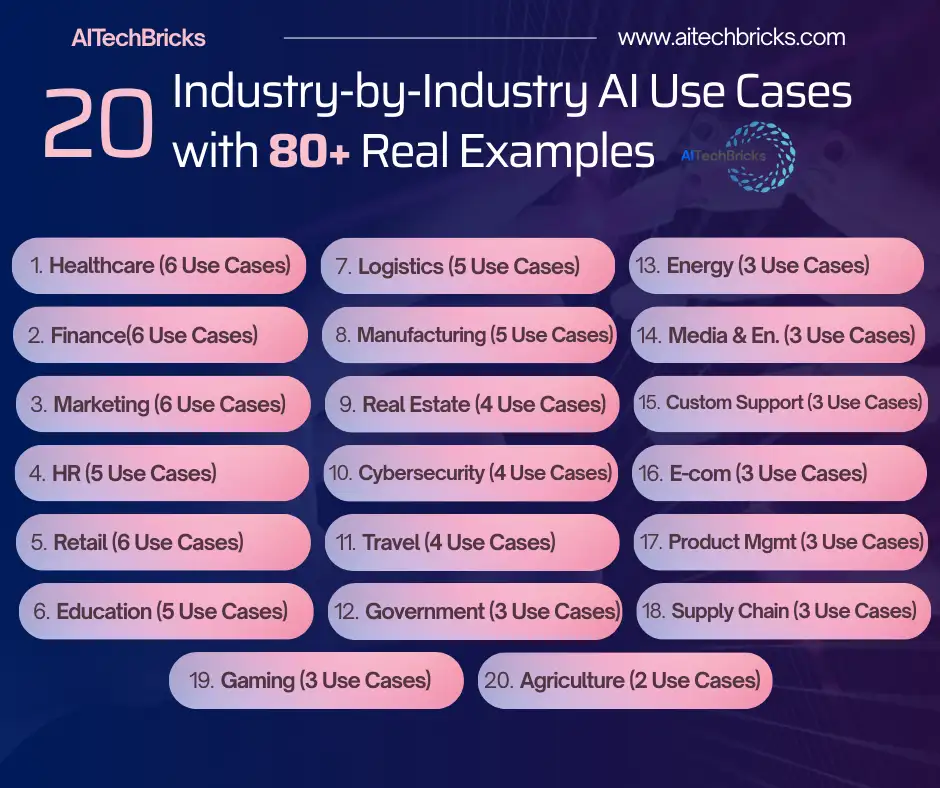
Total Coverage: 20 Industries
These industries span everything from healthcare to gaming, giving readers a panoramic view of where AI is actually used today.
80 Real Use Cases
Each industry contains 3–6 practical examples, adding up to 80 use cases across the guide.
Each Use Case Includes
For clarity and easy implementation, every use case follows the same structure:
Element | What It Covers |
Description | Simple explanation of the AI use case. |
Business Impact | What measurable benefit does it deliver? |
Tools Used | Real tools/LLMs/ML frameworks companies use. |
Difficulty | Beginner / Intermediate / Advanced. |
Industry-by-Industry AI Use Cases (80 Total)
Here we are going to cover all the AI 80 use cases from different industries. Check out below.
Healthcare (6 use cases)
Use Case | Description | Business Impact | Tools Used | Difficulty |
Medical Image Diagnosis (AI Radiology) | AI interprets X-rays, MRIs, CT scans. | Faster diagnosis, reduced workload. | Vision AI, PyTorch, Google Med-PaLM. | Advanced |
Predictive Health Analytics | Models forecast disease risk. | Better preventive care. | ML models, BigQuery, AutoML. | Intermediate |
Clinical Decision Support | AI assists doctors with evidence-based suggestions. | Higher accuracy, fewer errors. | LLMs, NLP models. | Intermediate |
Drug Discovery Optimization | AI identifies molecule targets. | Cuts R&D time and cost. | Bio AI tools, DeepMind AlphaFold. | Advanced |
Patient Triage Chatbots | Chatbots assess symptoms. | Reduced hospital load. | Dialogflow, LLM APIs. | Beginner |
Remote Monitoring & Wearables | Continuous tracking of vitals. | Early detection + reduced visits. | IoT sensors, ML. | Intermediate |
Finance (6 use cases)
Use Case | Description | Business Impact | Tools Used | Difficulty |
Fraud Detection | Detect suspicious transactions. | Prevents fraud losses. | ML, anomaly detection. | Advanced |
Credit Risk Scoring | Predict borrower behavior. | Better loan decisions. | ML scoring models. | Intermediate |
Algorithmic Trading | AI makes trading decisions. | Higher returns, automation. | Python, Quant AI tools. | Advanced |
Personal Finance Assistants | Chat-based budgeting help. | Better user retention. | GPT APIs, RAG. | Beginner |
Invoice Automation | AI extracts data from invoices. | Cuts manual entry time. | OCR, Vision AI. | Beginner |
AML/KYC Automation | Automates identity checks. | Speeds onboarding. | Vision, document AI. | Intermediate |
Marketing (6 use cases)
Use Case | Description | Business Impact | Tools Used | Difficulty |
Content Generation | AI writes posts, blogs, ads. | Faster output; lower cost. | GPT, Jasper, Copy.ai. | Beginner |
Predictive Segmentation | Finds customer clusters. | Better targeting. | ML clustering. | Intermediate |
Ad Optimization | AI tunes ad creative + budgets. | Higher ROAS. | Meta AI, Google Ads AI. | Intermediate |
Social Listening | Monitors brand sentiment. | Prevents PR issues. | NLP tools. | Beginner |
Email Personalization | Custom emails at scale. | Higher open rates. | HubSpot AI, LLMs. | Beginner |
Brand Voice AI Assistants | AI maintains brand consistency. | Faster content production. | LLM fine-tuning. | Intermediate |
Human Resources (5 use cases)
Use Case | Description | Impact | Tools Used | Difficulty |
Resume Screening | AI filters candidates. | Saves recruiter hours. | NLP, ATS AI. | Beginner |
Interview Automation | AI conducts first-round interviews. | Faster hiring funnel. | Interview AI, LLM bots. | Intermediate |
Retention Prediction | Predicts employee turnover. | Reduces attrition. | ML models. | Intermediate |
Onboarding Assistants | Answer employee questions. | Smooth onboarding. | ChatGPT API. | Beginner |
Learning Personalization | Tailors training content. | Better skill development. | LXP AI tools. | Intermediate |
Retail (5 use cases)
Use Case | Description | Impact | Tools Used | Difficulty |
Demand Forecasting | Predicts product demand. | Reduces overstock. | Time-series AI. | Intermediate |
Smart Inventory | Automated stock systems. | Prevents shortages. | IoT + ML. | Intermediate |
Visual Search | Search using images. | Better UX. | Vision AI. | Beginner |
Dynamic Pricing | Adjusts prices in real-time. | Higher revenue. | Pricing AI. | Advanced |
Store Analytics | Tracks in-store behavior. | Improves layout/placement. | Vision + sensors. | Advanced |
Education (5 use cases)
Use Case | Description | Business Impact | Tools Used | Difficulty |
Personalized Tutoring Systems | AI adapts lessons to each student. | Better learning outcomes. | LLMs, adaptive learning AI. | Intermediate |
Automated Grading | Grades essays, quizzes, coding tasks. | Saves teacher time. | NLP, Vision AI. | Beginner |
AI Study Assistants | Helps students summarize, revise, plan. | Improved productivity. | ChatGPT, Gemini, Claude. | Beginner |
Course Recommendation Engines | Suggests relevant courses. | Higher engagement. | ML recommendation models. | Intermediate |
Classroom Analytics | Identifies struggling students early. | Better intervention. | Data analytics + ML. | Intermediate |
Logistics (5 use cases)
Use Case | Description | Impact | Tools Used | Difficulty |
Route Optimization | Finds fastest delivery routes. | Lower fuel + time cost. | Optimization AI, Maps APIs. | Intermediate |
Fleet Management | Tracks and optimizes vehicles. | Reduced downtime. | Telematics + ML. | Intermediate |
Warehouse Automation | Robots manage picking/packing. | Faster order fulfillment. | Robotics AI. | Advanced |
Demand Forecasting | Predict stock needs. | Balanced inventory. | Time-series ML. | Intermediate |
Shipment Delay Prediction | Predicts delay risks. | Better communication + planning. | ML models. | Intermediate |
Manufacturing (5 use cases)
Use Case | Description | Impact | Tools Used | Difficulty |
Predictive Maintenance | Predicts equipment failure. | Prevents downtime. | ML + IoT. | Intermediate |
Defect Detection (Vision AI) | Finds product defects in real-time. | Higher quality. | CV models, PyTorch. | Advanced |
Process Automation | Automates repetitive factory tasks. | Higher efficiency. | Robotics + ML. | Intermediate |
Worker Safety Monitoring | Detects unsafe behavior or zones. | Reduces accidents. | Vision AI, sensors. | Intermediate |
Digital Twins | Virtual replicas of machines. | Better planning + testing. | Simulation + ML. | Advanced |
Real Estate (4 use cases)
Use Case | Description | Impact | Tools Used | Difficulty |
Property Valuation Models | Predicts property value. | Accurate pricing. | ML regression models. | Intermediate |
AI-Driven Listings | Auto-write property descriptions. | Saves agent time. | GPT, NLP. | Beginner |
Virtual Staging | AI adds furniture to photos. | Better conversions. | Vision AI tools. | Beginner |
Lead Qualification Bots | Scores incoming leads. | Higher sales efficiency. | Chatbots + ML. | Beginner |
Cybersecurity (4 use cases)
Use Case | Description | Impact | Tools Used | Difficulty |
Threat Detection | Flags security risks. | Prevents breaches. | ML + anomaly detection. | Advanced |
Anomaly Detection | Spots unusual access patterns. | Faster response. | ML models. | Advanced |
Phishing Prevention | Blocks suspicious links/emails. | Less employee risk. | NLP classifiers. | Intermediate |
Identity Verification | AI validates documents + faces. | Secure onboarding. | Vision AI. | Intermediate |
Travel (4 use cases)
Use Case | Description | Impact | Tools Used | Difficulty |
Dynamic Pricing | Adjusts flight/hotel prices. | Revenue optimization. | Pricing ML. | Intermediate |
Travel Recommendation Engines | Suggests destinations + itineraries. | Better booking experience. | ML + LLMs. | Beginner |
Real-Time Translation | Instant language translation. | Smoother travel. | LLMs, speech AI. | Beginner |
Smart Itineraries | AI builds custom trip plans. | Higher customer satisfaction. | LLMs + APIs. | Beginner |
Government (3 use cases)
Use Case | Description | Impact | Tools Used | Difficulty |
Citizen Service Chatbots | Handles public queries. | Faster service delivery. | LLMs, chatbots. | Beginner |
Resource Allocation Prediction | Forecasts demand for public services. | Better planning. | ML forecasting. | Intermediate |
Fraudulent Claims Detection | Flags suspicious applications. | Prevents misuse. | Anomaly detection. | Advanced |
Energy (3 use cases)
Use Case | Description | Impact | Tools Used | Difficulty |
Grid Optimization | Balances energy load. | Reduced outages. | ML + IoT. | Advanced |
Equipment Monitoring | Detects faults early. | Lower maintenance cost. | Sensors + ML. | Intermediate |
Consumption Prediction | Predicts usage spikes. | Efficient energy planning. | Time-series AI. | Intermediate |
Media & Entertainment (3 use cases)
Use Case | Description | Impact | Tools Used | Difficulty |
Content Recommendation | Suggests shows/music. | More engagement. | RecSys ML. | Intermediate |
Script Writing Assistance | AI supports content creation. | Faster production. | LLMs. | Beginner |
Video Automation | Auto-generate video edits. | Saves editing time. | Vision + GenAI. | Intermediate |
Customer Support (3 use cases)
Use Case | Description | Impact | Tools Used | Difficulty |
AI Chatbots | Automated customer answers. | Reduces agent workload. | GPT, Dialogflow. | Beginner |
Ticket Triage | Categorizes + routes tickets. | Faster resolution. | NLP classifiers. | Beginner |
Sentiment Analysis | Detects customer emotions. | Better responses. | NLP. | Beginner |
E-commerce (3 use cases)
Use Case | Description | Impact | Tools Used | Difficulty |
Product Recommendations | Suggests items based on behavior. | Higher conversions. | RecSys, ML models. | Intermediate |
Return Prediction | Predicts likelihood of returns. | Saves logistics cost. | ML classifiers. | Intermediate |
AI Shopping Assistants | Conversational product help. | Better customer experience. | LLMs, RAG bots. | Beginner |
Product Management (3 use cases)
Use Case | Description | Impact | Tools Used | Difficulty |
Feature Priority Scoring | AI scores features by impact. | Better roadmap decisions. | ML scoring models. | Beginner |
User Segmentation | Groups users based on behavior. | Clearer product insights. | Clustering ML. | Intermediate |
Release Impact Forecasting | Predicts launch performance. | Reduces launch risks. | Time-series ML. | Intermediate |
Supply Chain (3 use cases)
Use Case | Description | Impact | Tools Used | Difficulty |
Supplier Risk Analysis | Predicts supplier issues. | Fewer disruptions. | Predictive ML. | Intermediate |
Demand Planning | Forecasts product needs. | Smooth operations. | Time-series models. | Intermediate |
Inventory Optimization | Suggests ideal stock levels. | Lower carrying costs. | Optimization + ML. | Intermediate |
Gaming (2 use cases)
Use Case | Description | Impact | Tools Used | Difficulty |
NPC Intelligence | Smarter non-playable characters. | Better gameplay. | RL + ML. | Advanced |
Player Behavior Prediction | Predicts churn/spending patterns. | Higher retention. | ML models. | Intermediate |
Agriculture (2 use cases)
Use Case | Description | Impact | Tools Used | Difficulty |
Crop Monitoring | Analyzes crop health via images. | Early disease detection. | Drones + CV. | Intermediate |
Yield Prediction | Predicts production outcomes. | Better planning. | ML forecasting. | Intermediate |
AI Use Case Templates (Beginner-Friendly Frameworks)
Any team will be successful only when they know how to structure a use case, only then AI works.
Here we are sharing an AI use case ready-to-use template which you can apply in your workflow or industry.
Use this for proposals, internal projects, client pitches, or product planning.
AI Use Case Template (Copy & Use)
Section | What to Include |
1. Problem | The real business issue. One simple sentence. |
2. Goal | What “success” looks like — reduce time, cut cost, automate X. |
3. Current Workflow | How the process works today (and what’s broken). |
4. AI Solution | Describe how AI can improve or automate the workflow. |
5. Data Needed | The inputs required — text, images, logs, CRM data, etc. |
6. Models/Tech Used | LLMs, ML models, Vision AI, recommendation systems, etc. |
7. Tools/Platforms | LangChain, OpenAI API, Vertex AI, Snowflake, Zapier, etc. |
8. Expected Business Impact | ROI, time saved, cost reduced, accuracy gained. |
9. Difficulty Level | Beginner / Intermediate / Advanced. |
10. Risks & Limitations | Data quality, hallucinations, compliance, adoption challenges. |
11. KPIs to Track | Accuracy, latency, CSAT, cost savings, productivity metrics. |
Example Filled Template (Short Demo)
Section | Example |
Problem | Support team spends too much time answering repetitive queries. |
Goal | Reduce ticket volume by 40% within 90 days. |
Current Workflow | Agents manually answer FAQs and basic account questions. |
AI Solution | Deploy an LLM-powered chatbot with RAG for accurate responses. |
Data Needed | Help center articles, past tickets, product docs. |
Models/Tech | GPT-4.1, RAG pipeline, vector DB. |
Tools | OpenAI API, Pinecone, LangChain. |
Expected Impact | Faster replies, lower cost-per-ticket, higher CSAT. |
Difficulty | Beginner to Intermediate. |
Risks | FAQs not updated → poor responses. |
KPIs | Ticket deflection rate, response accuracy, user satisfaction. |
Tools Used Across AI Use Cases (Categorized)
To successfully run these AI use cases, we must utilise AI tools. Here, I am going to list all the tools from different categories so you can pick the right stack.
Large Language Models (LLMs)
Tools | Best For |
OpenAI GPT | Chatbots, summarization, workflows, coding help |
Anthropic Claude | Research tasks, long-context reasoning |
Google Gemini | Search + multimodal tasks |
Llama / Mistral | Open-source LLM deployments |
Cohere Command | Enterprise text workflows |
Machine Learning Frameworks
Tools | Best For |
TensorFlow | Deep learning models |
PyTorch | Research + production ML |
Scikit-learn | Classic ML models |
XGBoost / LightGBM | Tabular ML excellence |
JAX | High-performance training |
GenAI Workflow Tools (RAG + Agents)
Tools | Best For |
LangChain | RAG pipelines + agents |
LlamaIndex | Document indexing + retrieval |
Haystack | Retrieval QA systems |
Pinecone / Chroma / Weaviate | Vector databases |
LangFlow | No-code AI workflow builder |
Vision AI Tools
Tools | Best For |
OpenCV | Image processing |
YOLO / Detectron2 | Object detection |
Google Vision AI | OCR + document extraction |
Amazon Rekognition | Face + object recognition |
Roboflow | Image dataset labeling |
Automation Tools
Tools | Best For |
Zapier + AI | Automating workflows |
Make.com | Cross-app automations |
Airtable AI | Smart business operations |
Notion AI | Internal knowledge workflows |
UiPath | RPA + AI automation |
Cloud Platforms for AI
Tools | Best For |
Google Vertex AI | End-to-end ML + LLM pipelines |
AWS SageMaker | ML deployment at scale |
Azure AI Studio | Enterprise LLM apps |
Snowflake Cortex | AI + data warehouse combo |
Databricks | Unified data + AI |
Data & Analytics Tools
Tools | Best For |
BigQuery | Scalable analytics |
Apache Spark | Big data processing |
Tableau / Power BI | Visual dashboards |
dbt | Data transformations |
Airbyte / Fivetran | Data connectors |
Evaluation & Monitoring Tools
Tools | Best For |
MLflow | Experiment tracking |
Weights & Biases | Research + model monitoring |
TruLens | LLM evaluation |
Arize AI | Drift monitoring |
Promptfoo | Prompt testing |
Multimodal / Creative AI Tools
Tools | Best For |
Midjourney | Images + branding |
Runway ML | Video creation |
Pika Labs | AI video generation |
ElevenLabs | Voice cloning |
Leonardo.ai | Image creative workflows |
How to Implement AI Use Cases in Your Business
AI only delivers ROI when businesses follow a structured approach.
Here is a simple, no-nonsense framework teams can use to turn ideas into working AI systems.
Step-by-Step Implementation Framework
Step | What You Do | Why It Matters |
1. Identify the Problem | Pick a workflow that’s slow, expensive, or repetitive. | AI works best on real pain points — not “cool ideas.” |
2. Evaluate AI Fit | Decide if AI truly adds value (automation, prediction, personalization). | Prevents wasted money on unnecessary AI projects. |
3. Gather the Data | Collect documents, logs, messages, images — whatever the model needs. | Clean data = accurate output. |
4. Choose the Model | LLM? Vision? ML? Recommendation engine? | The right model decides 80% of success. |
5. Pick the Tools | LangChain, Vertex AI, OpenAI API, Zapier, etc. | Tools make implementation faster. |
6. Build a Small MVP | Start with one workflow or one team. | Avoids big-bang failures; fast learning cycle. |
7. Test With Real Users | Measure accuracy, speed, satisfaction. | AI that looks good on paper may fail in practice. |
8. Deploy & Monitor | Track drift, errors, performance. | AI needs continuous tuning. |
9. Measure ROI | Hours saved, revenue increased, errors reduced. | Proves the project’s value to stakeholders. |
Start small, automate one workflow, measure impact, then scale it across the business.
10 Most Profitable AI Use Cases (High ROI)
These are the AI use cases companies adopt first because they deliver fast, measurable, high-impact returns.
Perfect for businesses, consultants, and product teams.
Top 10 High-ROI AI Use Cases
Use Case | Why It’s Profitable | Industries Using It |
1. Predictive Maintenance | Prevents costly equipment failures. | Manufacturing, Energy, Logistics |
2. Dynamic Pricing | Increases revenue automatically. | E-commerce, Travel, Retail |
3. Fraud Detection | Saves millions in fraud losses. | Finance, Payments, Insurance |
4. Customer Support Automation | Reduces workload by 40–70%. | SaaS, E-commerce, Telecom |
5. Personalized Recommendations | Boosts conversions instantly. | E-commerce, Media, Retail |
6. Lead Scoring & Qualification | Improves sales efficiency. | Real Estate, SaaS, B2B |
7. Invoice & Document Automation | Removes manual processing. | Finance, HR, Operations |
8. Churn Prediction | Saves at-risk customers early. | SaaS, Telecom, Streaming |
9. Demand Forecasting | Cuts inventory costs. | Retail, Supply Chain, Manufacturing |
10. AI-Assisted Content Generation | Reduces content cost by 60–80%. | Marketing, SaaS, Agencies |
These aren’t “nice to have” use cases; they are money makers.
If a company wants a fast win, they start here.
Future of AI Use Cases (2025–2030)
Would you like to see how these AI use cases are headed to 2025 and beyond? Here is a simple breakdown for the future AI.
Near-Term (2025–2026) — Rapid Adoption Phase
Trend | What It Means |
AI copilots everywhere | Workflows become chat-based and automated. |
RAG becomes standard | Every business uses retrieval AI for knowledge. |
LLM agents | AI handles multi-step tasks autonomously. |
AI personalization | Every user gets a unique experience. |
Mid-Term (2027–2028) — Specialization Phase
Trend | What It Means |
Synthetic data boom | Companies train models without privacy concerns. |
AI governance roles expand | Compliance, audits, ethics become mandatory. |
Multi-agent ecosystems | AI systems talk to each other, not just humans. |
AI-driven operations | Demand planning, logistics, HR shift to autopilot. |
Long-Term (2029–2030) — Autonomous Enterprise Phase
Trend | What It Means |
AI-run departments | Marketing, support, operations become AI-led. |
Edge AI everywhere | Real-time intelligence in devices & sensors. |
Enterprise-wide AI agents | End-to-end processes become fully automated. |
Personalized AI models | Custom AI per employee, customer, and product. |
Conclusion
AI use cases are no longer experimental.
They are the fastest way businesses reduce costs, automate workflows, and create better customer experiences.
Across 20 industries and 80 real examples, one pattern is clear:
- Companies that adopt practical AI use cases grow faster.
- Companies that delay lose their advantage.
Whether you are exploring AI for your career, product, or business, start small, measure impact, and scale the use cases that deliver real value.
This guide is your starting point and your roadmap.
If you have any queries, feel free to comment them below and we will be happy to help you.