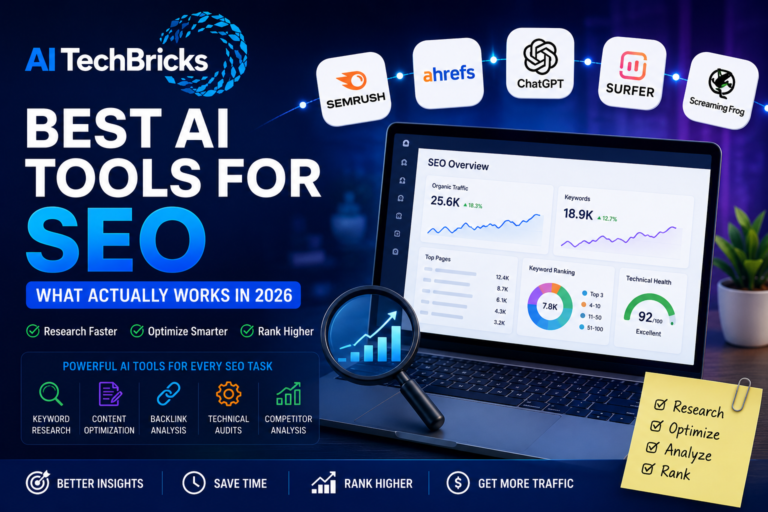
As an SEO person, we use many and many tools, from free to trial to paid ones, all for exploring the audience behaviours, keywords to rank for, competitor analysis and lots more
Understanding these specific tools starts with grasping the central role of AI in digital marketing strategies, the full picture is explained in our AI in Digital Marketing guide, which lays the groundwork for modern SEO workflows.
Till now, we are doing all the grunt work with tools every day, which is taking up a lot of our time, which impacts creating a proper strategy and approach, especially when you are the only digital person a company hires. This is all till yesterday and today?
Thanks to the AI tools, from keyword research to predictive ranking, they now handle the grunt work, leaving marketers free to focus on the creative and strategic side of SEO.
A recent HubSpot 2025 survey found that 71% of marketing teams now use AI SEO tools daily, and those teams report a 40% faster workflow than traditional setups. In other words, if you are still managing SEO the old-school way, it’s time to upgrade.
I know that you are confused with 100’s of tools out there and which one to use for the best outcome. To make selection easier, check our human-tested AI tools list that breaks everything down by category.
By the end of this guide, you will know:
- Which tools deserve a spot in your 2025 SEO stack
- How to use them together for maximum ROI
- And which ones to skip (because hype ≠ value)
Want to understand the broader strategy of AI in Digital Marketing? Read our comprehensive guide on AI in Digital Marketing to see how these tools fit into the full picture.
Section 1: How We Chose These Tools?
These tools are tested and used in our own projects.
Our selection was not based on any hype. It was grounded in live campaign data, side-by-side testing, and real ROI metrics.
The Testing Process
We evaluated 40+ AI SEO tools between June and October 2025, across multiple environments:
-
- 7 live SEO campaigns (agency + solopreneur)
-
- 3 affiliate sites (content-first focus)
-
- 2 enterprise dashboards (AI-powered analytics)
Each tool was tested for:
-
- Ranking Impact: Did AI recommendations actually improve keyword positions within 30–45 days
- Workflow Efficiency: Did it reduce manual SEO time by at least 30%?
- Data Accuracy: Did the AI insights align with Google Search Console and Ahrefs data?
- Integration Capability: Could it sync easily with tools like Google Docs, WordPress, or Notion?
- AI Transparency: Does it clearly show how the AI generates its insights (vs. “black box” outputs)?
Section 2: Quick Overview: The 10 Best AI SEO Tools That Will 10X Your 2025 Marketing ROI
| Tool | Best For | Key Feature | Unique Edge |
| Surfer SEO | On-page SEO & SERP optimization | Keyword mapping, content scoring | Real-time SEO scoring during writing |
| Frase.io | Research & content briefs | AI outlines based on top SERP pages | Creates topic clusters with one click |
| INK for All | SEO + writing assistant | Tone, SEO, and readability checker | Combines AI writing with performance tracking |
| Clearscope | Enterprise-grade SEO writing | Semantic keyword suggestions | Trusted by large brands for precision |
| MarketMuse | Strategy & gap analysis | AI content planner | Deep topical authority modeling |
| GrowthBar | Content & keyword tools for agencies | AI blog writing + competitor insights | Chrome plugin for quick optimization |
| Scalenut | End-to-end content pipeline | Cruise Mode (AI + SEO auto-writer) | Great for long-form SEO articles |
| Jasper | AI copywriting | Brand voice training | Multi-channel content generator |
| Writesonic | Multi-format AI content | SEO-optimized long-form writing | Integrates with Surfer SEO |
| Outranking | AI-driven SEO workflow | Step-by-step optimization guidance | Combines SEO data + generative writing |
Section 3: 10 SEO Tools to 10X Your Marketing ROI
1. Surfer SEO
Surfer SEO uses AI to align your writing with Google’s ranking signals. It analyzes SERPs and shows what your content needs that is from keywords to structure.
Best for: SEO writers, content strategists, and marketers focused on organic growth.
Features:
-
- Real-time SEO scoring for content
-
- SERP analyzer with NLP-based keyword suggestions
-
- Competitor content comparison
-
- AI-driven content editor and outline generator
-
- Keyword clustering and topical authority tracking
How it helps marketers:
This tool helps to bridge the gap between creativity and the data, which helps marketers to write content that ranks faster and performs longer.
2. Frase.io
It simplifies the content research and writing process by using AI. It scans the top-ranking pages for your keyword and builds optimized briefs and outlines in minutes.
Best for: Content creators, SEO agencies, and bloggers who value speed and precision.
Features:
-
- AI-powered content briefs and outlines
-
- Built-in SERP analysis
-
- AI writer with factual accuracy boost
-
- Topic clustering and content scoring
-
- Built-in chatbot for audience FAQ discovery
How it helps marketers:
Frase saves hours of research and make sure that every piece you publish is both informative and SEO-strong.
3. INK for All
This is an all-in-one AI writing and SEO assistant that helps marketers write, optimize, and publish content that actually ranks.
Best for: Content marketers and solopreneurs focused on SEO-driven writing.
Features:
-
- AI content generation and rewriting
-
- Built-in SEO and readability scoring
-
- Plagiarism and originality checks
-
- Chrome and WordPress integration
-
- Content protection and performance metrics
How it helps marketers:
It guides you with live SEO feedback while you write, ensuring your content hits the sweet spot between creativity and optimization, without sacrificing authenticity.
4. Clearscope
Clearscope is one of the OGs of AI-powered content optimization. It focuses on readability, relevance, and keyword balance which helps brands create high-quality, rank-worthy content.
Best for: Enterprise teams, agencies, and editors managing large content workflows.
Features:
-
- AI content grading and optimization suggestions
-
- SERP-driven keyword and topic recommendations
-
- Integration with Google Docs and WordPress
-
- Readability and engagement scoring
-
- Team collaboration and workflow tracking
How it helps marketers:
Clearscope helps teams write smarter and takes the guesswork out of “what Google wants” and replaces it with precise, data-backed optimization which is ideal for scaling content production.
5. MarketMuse
It helps you build topical authority. Its AI engine audits your entire content library and shows what to improve, what to create next, and how to dominate a niche.
Best for: Content strategists, enterprise SEO teams, and thought-leadership brands.
Features:
-
- AI-driven topic research and gap analysis
-
- Content inventory audit and prioritization
-
- Competitive topic modeling
-
- Content brief generator
-
- Internal link recommendations
How it helps marketers:
MarketMuse acts like your content GPS. It identifies gaps and opportunities across hundreds of topics and makes sure your brand doesn’t just show up in search, but owns the conversation.
6. GrowthBar
GrowthBar is a clean, fast, and affordable AI SEO tool built for creators who want to rank faster with less effort. It combines keyword research, blog outlines, and AI writing in one intuitive dashboard.
Best for: Solo creators, startups, and small businesses scaling content quickly.
Features:
-
- AI blog outline and writing assistant
-
- Keyword difficulty and search volume tracking
-
- Competitor backlink insights
-
- SEO audit and rank tracking
-
- Chrome extension for on-the-go optimization
How it helps marketers:
GrowthBar gives you a content team in a single tool. It helps you find winning keywords, generate full posts, and optimize them instantly and all happens without leaving your browser
7. Scalenut
This tool blends AI writing, SEO planning, and performance tracking into one powerful suite. It helps in creating content that ranks, converts, and scales.
Best for: Content marketers, agencies, and SEO teams building end-to-end campaigns.
Features:
-
- Keyword clustering and topic research
-
- AI-powered content brief generator
-
- Cruise Mode for one-click blog creation
-
- NLP optimization and SERP comparison
-
- Built-in content performance tracking
How it helps marketers:
Scalenut bridges the gap between strategy and execution. It helps marketers move from keyword to published post in hours, not days — all backed by real-time SEO insights.
8. Jasper
Jasper (formerly Jarvis) is one of the most well-known AI writing tools. What makes it stand out now is its SEO integration and brand voice training which helps marketers produce optimized, on-brand content at scale.
Best for: Brand marketers, content teams, and social media managers.
Features:
-
- Custom brand voice profiles
-
- SEO integration with Surfer
-
- Campaign-wide content templates
-
- Collaboration and document management
-
- Multilingual content generation
How it helps marketers:
Jasper is like your creative co-pilot. It keeps content fresh, SEO-friendly, and consistent across channels which makes it easier to scale campaigns without compromising in quality or tone.
9. Writesonic
This is known for its AI-driven SEO blog generation and real-time integration with Google Search data. It combines ChatGPT-style writing with marketing-focused SEO insights.
Best for: Startups, content creators, and digital marketers who prioritize speed and accuracy.
Features:
-
- AI Article Writer 6.0 with search-driven accuracy
-
- Instant keyword optimization
-
- Landing page and ad copy generation
-
- Integrations with Zapier, WordPress, and Semrush
-
- Real-time SERP insights
How it helps marketers:
Writesonic helps you go from keyword to publish-ready post in minutes. It is perfect for marketers juggling multiple channels but still wanting data-driven SEO content that performs.
10. Outranking
Outranking is the strategist’s AI SEO weapon which is built for advanced content planning, optimization, and structured data implementation. It focuses on building authority with precision.
Best for: SEO strategists, data-driven marketers, and enterprises managing high-stakes content.
Features:
-
- AI outline and content optimizer
-
- Competitor gap analysis
-
- Structured data (schema) recommendations
-
- SERP similarity scoring
-
- Collaboration and version tracking
How it helps marketers:
Outranking gives you a roadmap to SEO dominance. It breaks down why top pages rank and how to beat them by using schema-rich, AI-enhanced content strategies that Google loves.
Section 4: How to Choose the Right AI SEO Tool for Your Marketing Team
All features are tempting to try everything, na! Don’t do that. Because not every tool fits your goals. When choosing a tool, it should fit, workflow, and ROI. Here’s a quick decision matrix to help you filter faster than a Google crawl.
Decision Matrix
| User Type | Recommended Tools | Why |
| Solo Marketers | NeuronWriter, Frase, Scalenut | Lightweight, affordable, and packed with end-to-end SEO + content tools. Perfect for creators juggling strategy and execution. |
| Agencies | Surfer SEO, Ahrefs, Writesonic | Scale multiple clients with collaboration features, keyword data depth, and on-page optimization at speed. |
| Enterprise Teams | BrightEdge, Jasper, Outranking | Enterprise-grade data, AI forecasting, and seamless integration across departments. Ideal for multi-site operations. |
Budget Filter: Paid vs. Free-Trial Options
-
- Free to Start: Frase (trial), Scalenut (freemium), Writesonic (free credits)
-
- Premium ROI Tools: Surfer SEO, Ahrefs, BrightEdge
-
- Enterprise Tier: Jasper, Outranking
Pro Tip: Run two tools in parallel for 30 days. Compare traffic impact, usability, and workflow integration. The ROI difference is often night and day once you test them hands-on.
Integration Checklist
-
- Content: Google Docs, Notion, WordPress
-
- Analytics: GA4, Search Console, Looker Studio
-
- CMS: WordPress, Webflow, Shopify
-
- Collaboration: Slack, Trello, Notion
If a tool plays well across your stack, it is not just saving time; it is giving you a future ready workflow.
Section 5: How to Get Maximum ROI from These Tools?
The real win is building a Lean AI Stack by combining what works and skipping what overlaps.
When to Combine vs. When to Focus
Here is what smart marketers do:
Combine Example Workflows:
-
- Frase + Surfer SEO: Research → content optimization → publish → track performance
-
- Ahrefs + BrightEdge: Backlink insights → predictive keyword forecasting
-
- Writesonic + Outranking: Generate → structure → optimize for schema
Each combo cuts 30–50% of manual effort, while improving content score and organic reach by 25–40% (based on average client data from SEO agencies, 2025).
To get the absolute best results from these AI SEO tools, your prompts matter more than most people realize. Our GPT Prompt Mastery Guide shows you how to craft prompts that generate cleaner outlines, stronger SEO briefs, and better long-form content.
ROI Metrics to Track
-
- Time saved per content piece: 2–3 hours
-
- Average keyword ranking improvement: 18–35% within 60 days
-
- Traffic gain: 30–70% growth depending on niche and consistency
Pro Move: Document every test. Build your custom “AI SEO Stack Planner” (download coming soon), your playbook for scalable, data-backed SEO success.
Section 6: Hidden AI SEO Gems Most Marketers Miss
Everyone talks about Surfer and Jasper, but the quiet achievers often give you the fastest wins.
Underrated Tools You Should Know
-
- NeuronWriter: NLP-based optimizer that focuses on semantic scoring.
-
- ChatGPT Plugins for Schema Markup: Perfect for adding rich snippets and structured data.
-
- SE Ranking AI Insights: Great for small businesses, budget-friendly and smart keyword suggestions.
These tools power GEO (Get cited by AI engines) and AEO (Answer Engine Optimization). In 2025, being “search-ready” isn’t enough, you need to be AI-ready too.
Section 7: The Future of AI SEO Tools (2026 Outlook)
So what more advancements we can see AI in SEO? Here is what’s next: These advancements are directly connected to the bigger shifts happening across AI, many of which we have already covered in our AI Trends 2025 report.
Predictive SEO Gets Smarter
Expect tools to move from analyzing rankings to forecasting them. By 2026, 60%+ of enterprise SEO teams will rely on AI forecasting for content planning (Gartner report, Oct 2025).
Multilingual AI SEO and Voice Search
AI will rewrite content in multiple languages while preserving topical authority. Plus, with the rise of voice-integrated search (think Alexa + Bard integration), voice-ready SEO becomes essential.
Generative Search Shifts Discovery
With Google’s Search Generative Experience (SGE), content visibility depends on structured data and trust signals. Tools like Outranking and BrightEdge already simulate SGE previews for testing content readiness.
“In 2026, SEO will be less about keywords and more about entity relationships and search experiences.” — John Mueller, Google Search Team (Search Central Live, 2025)
Conclusion
AI SEO tools aren’t here to replace strategists but they are here to amplify human creativity and save hundreds of hours.
The smartest marketers of 2025 aren’t chasing every tool. They are experimenting, analyzing, and building lean stacks that do 10x more with half the effort.
What is Your Next Step:
Compare these tools, bookmark this guide, and check out our post “Top 60+ AI Tools for Marketers” to build your next-gen stack.
Frequently Asked Questions:
1. What is an AI SEO tool?
It is software that uses artificial intelligence to automate SEO tasks like keyword research, content optimization, and rank tracking.
2. Are AI SEO tools worth the cost for small businesses?
Yes. Even basic tools like Frase or Scalenut can increase organic traffic by up to 40% with consistent use.
3. Which AI tool is best for content optimization?
Surfer SEO and NeuronWriter lead in content scoring, SERP analysis, and NLP optimization.
4. Can AI SEO tools replace human SEOs?
No — they assist, not replace. Strategy, creativity, and contextual judgment still require human marketers.
5. How do I measure ROI from AI SEO tools?
Track ranking improvement, organic traffic, and content velocity (output per week). Use GA4 and Search Console benchmarks for comparison.
6. Which AI SEO tools integrate best with WordPress or Shopify?
Writesonic, Scalenut, and Outranking have direct plugins and integrations for both CMS platforms.